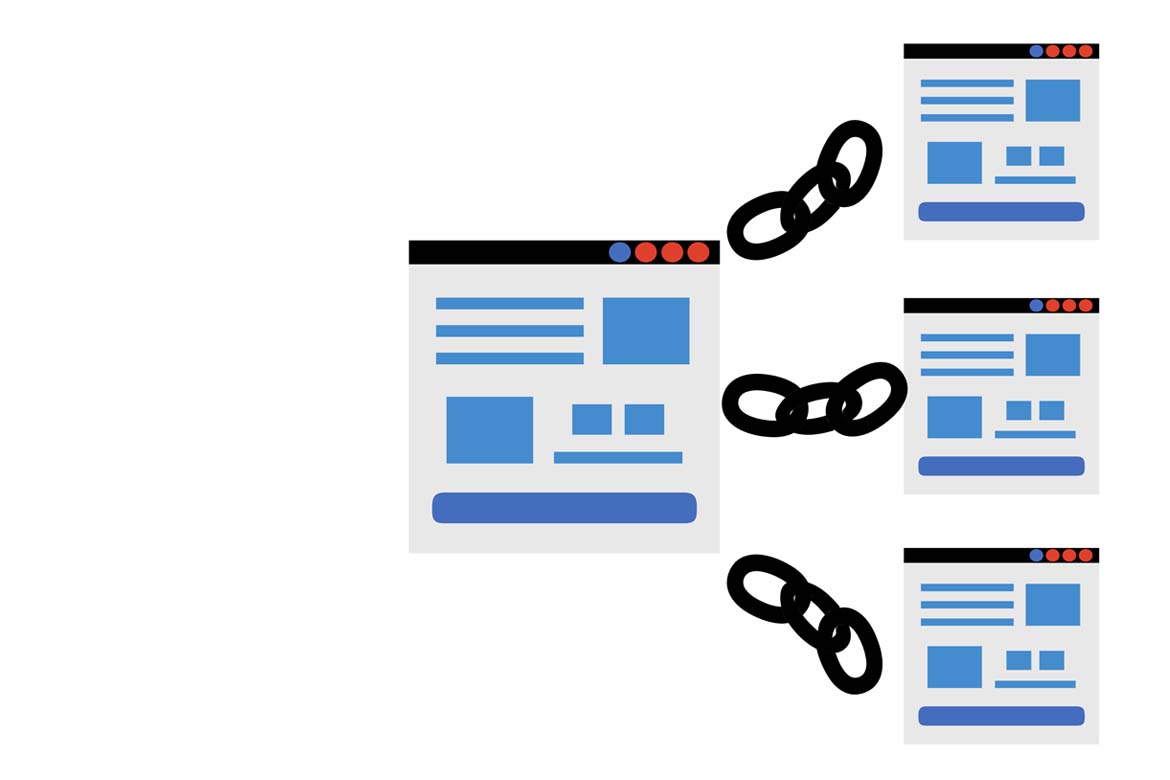

In SEO, all those external links from another domain to yours are called backlinks. A backlink is, therefore, a reference from one website to another. They are also known as incoming links or backlinks and denote a certain trust in the page to which it refers.
Why are backlinks important for SEO?
The links between different websites are the core of the global computer network (the World Wide Web). It is through hyperlinks that the computer networks that constitute the essence of the internet are created. Search engines need these connections between websites to find and index information. This is because web spiders use links to move around pages. As well as being the foundation of the internet, links are particularly relevant for search engine optimization.
Thus, backlinks play a unique role in the context of SEO methods as they allow search engines to determine which websites are most frequently referred to regarding a specific topic. In this way, its level of relevance or “quality” is also established, which is considered to position better or worse. For all these reasons, in addition to dealing with the on-page SEO of a website, it is necessary to obtain links from other pages through off-page link-building techniques.
As these links are interpreted as recommendations in favor of your website, the greater the number of backlinks, the greater relevance and authority your website will have, and an improvement in the positioning of the SERP.
With each backlink, your website gains a little more value, called link juice. This term refers to all the favorable properties of a link that are transferred to its source page. However, not all links have the same effect on SEO, and therefore, not all of them improve positioning. For example, backlinks to the home page only increase the website’s overall authority. On the other hand, the links that redirect to subpages with specific content can directly improve the ranking of the topic discussed on the page.
This requires, however, a thematic coherence between the linked sites. A link between completely different content will only slightly increase the importance of a website.
What makes a good backlink?
Google places much more importance on quality than the number of backlinks. This is because Google tries to counter the buying and selling of hyperlinks, thus ensuring the reliability of each backlink.
What type of backlinks can improve the quality of an incoming link profile and, therefore, the SEO strategy?
First of all, inbound links should come from reputable and trustworthy websites. For example, web pages of universities, public institutions, etc. These types of domains are highly trusted repositories and therefore have the power to increase the credibility of a website.
In contrast, if websites of questionable quality display your backlinks, this could negatively affect a website. Avoid linking a website to spam pages used solely and exclusively to generate incoming links. Which, in some cases, could cause a page to be removed from the Google index.
On the other hand, inbound links should come from thematically relevant websites. A thematic connection between related pages makes your backlinks more critical. As a result, the rating of a web page improves, and with it, its positioning.
Also, the most credible backlinks usually come from the same country and industry. Google considers these links much more plausible than those made from distant lands, with no apparent connection to the target website. For example, if an online sports store in Germany receives a backlink from an electronics service provider in India, this is recorded as abnormal activity. As a consequence, Google could conclude that said link was acquired illegally.
Another essential feature of a good backlink is appropriate to anchor text containing the most important keywords for the destination web page. Its function is to help improve the ranking or positioning of the website about the corresponding search queries. Creating inbound links whose anchor text contains the exact main keywords is quite a cumbersome process. This is because companies are often associated with their names and not with the search terms that are relevant to them. Also, too many anchor texts with the exact main keyword are unnatural and can be classified as spam.
The thematic similarity of the website where the link has been created is equally decisive. You must ensure that the contents coincide with those of the web that receives the connection. Otherwise, it could also make them look forced and increase the risk that they will be interpreted as spam.
Imagine, for example, that a blog post about a cookbook contains a link with the following anchor text: “Credit No Background Check.” In addition to not being beneficial for readers, this has an unnatural aspect for Google; therefore, it is very likely that it will be rated negatively.
Also, it is recommended to get more dofollow inbound links than nofollow. Nofollow links do not add authority to a website and therefore influence a page’s ranking less than a dofollow link would.
Last but not least, you should consider how recent these links are. Adding new links regularly suggests that a website provides users with up-to-date content, which translates into a positive rating from Google.
In short, backlinks must meet the following requirements to be favorably evaluated by Google: . Reliable and reputable source.
. Thematic consistency between linked pages.
. Created in the same country, industry, etc.
. Keywords in the anchor text.
. Anchor text that is related to the content of the page in question.
. More follow links than nofollow.
. Recently Added Links.